Alpha Succession Law
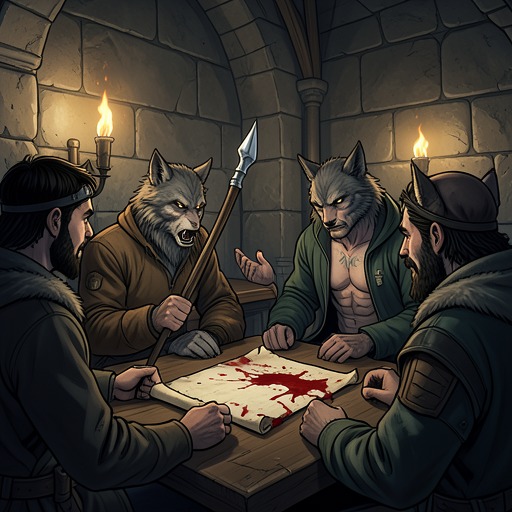
The Vampire Prince’s BrideAlpha Succession Law is the governing succession rule of the New York Pack, defining an Alpha’s authority not as a permanent inheritance but as a position that must be continually justified through dominance and male reproduction. Its most immediate effect is to make Eric McKenna’s first year as Alpha a countdown: unless he produces a healthy son before the year expires, he must surrender the position. The law therefore binds Pack sovereignty to two forms of proof—victory over challengers and the birth of a male heir—and turns private fertility into a public condition of political legitimacy.
Definition and Requirements
The law recognizes the late Alpha’s first-born son as entitled to claim his father’s position, but entitlement alone is insufficient. A candidate must establish undisputed dominance by defeating every rival who formally challenges him. Eric’s succession was unusually uncontested: after his father, Richard McKenna, died, the Pack approached Eric’s older brother, Hector McKenna, first. Hector refused the office, leaving Eric as the next eligible son, and no Challenger appeared either when Eric assumed the title or afterward.
The law also imposes a reproductive requirement. A newly installed Alpha has one year to prove fertility by having a healthy son. Earlier Alphas who already possessed families before taking power generally faced no immediate difficulty; where an existing Alpha had daughters but no son, the period could extend to three years. A childless Alpha, however, has only one recognized outcome under the rule: he must give up the position. The statute thus treats a son not merely as a family member but as evidence that the ruling Alpha can continue the Pack’s political line.
Eric McKenna’s Succession Crisis
Eric’s year is nearly over when Bianca Jamison enters McKenna Enterprises, making the law the pressure point behind his personal and political crisis. His Beta, Brian, repeatedly reminds him that an Alpha requires both “Might and issue”: the strength to preserve the title and the offspring needed to secure it. Eric has already attempted to meet the reproductive demand, sleeping with nearly every willing she-wolf since obtaining the title. Yet those encounters feel forced and clinical to him rather than intimate, and the repeated failure to produce a son leaves the legal deadline approaching with no solution.
The Pack’s biology makes the requirement especially coercive. Werewolves possess heightened senses and the ability to shapeshift, but their supernatural condition also makes them far less fertile than humans. Eric refuses to exploit that difference by impregnating a human woman who does not understand what joining his world would mean, particularly because a child of a werewolf is always a werewolf even when only one parent is supernatural. To avoid an accidental pregnancy and the moral consequences of taking a child away from an uninformed mother, he stops having sex with human women altogether. The succession law consequently reaches beyond public office: it governs whom Eric considers himself permitted to desire, how he evaluates potential partners, and whether reproductive necessity can override consent and responsibility.
Bianca changes that calculation because Eric cannot ignore his reaction to her. Her scent awakens the wolf in him almost immediately, while her human identity places her outside the reproductive pattern he has been following with Pack women. The attraction is therefore inseparable from danger. She appears at the exact moment when Eric’s formal duty is most urgent, but the law offers no simple protection for either of them: it creates pressure for an heir without resolving the ethical problem of involving a human in Pack succession.
Political Enforcement and Family Conflict
Alpha Succession Law also structures the relationship between Eric and Hector. When Jason McKenna discovers traces suggesting theft from McKenna Enterprises, suspicion threatens to turn the brothers against one another. Eric approaches Hector directly because the company is not merely a family business: its original investors and current shareholders are Pack members, roughly a third of its employees belong to the Pack, and every director is a Pack member. The corporate crisis is therefore also a succession crisis, since any accusation that weakens the Alpha’s family can destabilize the Pack’s political center.
Hector rejects the suggestion that he would steal from the company and reminds Eric that he could have taken their father’s place by right. Instead, he refused when the Pack came to him after Richard McKenna’s death, forcing the office onto Eric. His refusal clarifies the distinction between legal eligibility and political will. Hector possessed the senior claim, but Eric became Alpha because the succession order moved to the next son after Hector declined. Even so, Hector remains the Pack’s most formidable fighter, and Eric understands that a conflict between them could be decided in the Pits. The law’s promise of orderly inheritance therefore exists alongside the ever-present possibility of physical challenge.
Eric’s response to the corporate accusation shows how the law encourages defensive coalition-building. He tells Hector that he does not believe his brother stole from the company, while also acknowledging that Jason found genuine traces. Eric suspects that an outside actor is manipulating the family into attacking itself. Preserving the Alpha’s position requires more than producing a son; it requires preventing rivals and hidden enemies from converting internal mistrust into a formal or violent challenge.
Institutional Consequences
The law produces an elaborate apparatus around the Alpha’s household. At the Big House, the mansion serving as the home of the Alpha and his immediate family, Brian waits with the eight remaining members of the Alpha Guard. Their duty is to protect the Pack, the Alpha, the Alpha’s Mate, and the children in that order. This hierarchy reveals how succession law extends protection outward from the prospective heir: the Mate and children are political assets as well as family members, and the security of the household becomes part of the security of the regime.
That protection becomes urgent when Eric brings Bianca into the compound after an attack. Bianca is pale, shivering, and too traumatized to leave the car without Janet’s help. Eric wants to punish the person who made her feel unsafe, but bringing her into the Pack’s protected household also exposes her to a world she had not chosen. The law’s reproductive demand and the Pack’s security structure converge around her, transforming a stranger into someone whose safety may affect the Alpha’s future while making her vulnerable to the consequences of his office.
The law also belongs to a broader pattern in which institutions suspend ordinary personal freedom in the name of political continuity. Elsewhere in the story, Priest Quincy sends Cheryl and the two Kings Presumptive to the Shrine of Nethja until the alignment of the four moons, ordering that the father of any resulting child become king and that both men die if she is not pregnant. The Fifth Cycle Festival similarly turns a woman chosen as the Goddess into the prize of a lethal male contest, despite the United Species having banned the tradition because the Goddess was often killed and eaten. These parallel systems differ in setting and species, but each makes reproductive or sexual control a mechanism for selecting rulers. Alpha Succession Law is less openly ritualized, yet it likewise places a woman’s body, a child’s sex, and a leader’s legitimacy inside the same political equation.
Narrative Significance
Alpha Succession Law gives Eric’s romance with Bianca a structural stake beyond attraction. His need for a son is not a private wish and not simply family pressure; it is a legal condition that can remove him from power within a specified period. His reluctance to use uninformed human partners makes the rule morally uncomfortable even before Bianca appears, while his immediate response to her creates the possibility that duty and desire may collide rather than neatly reinforce one another.
The law also exposes the instability beneath Pack tradition. Eric inherits the position because Hector refuses it and remains secure only so long as no challenger defeats him and a son is produced. In that arrangement, succession is simultaneously hereditary, competitive, and biological. Bloodline opens the door, physical dominance guards it, and reproduction keeps it open. The result is a political order in which authority can look inherited while remaining permanently conditional, and in which the Alpha’s body is treated as evidence for the future of the entire Pack.